Some bodies of work announce themselves through scale. Noah Parslow's announces itself through concentration. Many of the 121 works considered here are five by seven inches, the dimensions of a postcard or a votive, and each one carries a surprising amount of feeling for its size. Pigment is flooded, lifted, scrubbed back with a copper brush, repelled with alcohol, coaxed into blooms with ox gall and held at the edge with gum arabic. The paper is abraded, singed, dyed with indigo, or exchanged for translucent synthetic sheets on which the paint sits and floats. What results is less a set of pictures than a set of conditions, each sheet a small climate an image has to live in.
His images are few, and he returns to them often: his own traced hand, posed in the gestures of Buddhist iconography; moths and their painted eyes; the household cat; the songbird; the vivid, flattened figures of digital illustration. Across six years the returns keep finding something new. Parslow is a painter of repetition under changing weather, and his titles say so plainly: Hand in Cold Dawn Rain, Hand in Afternoon Sleet.
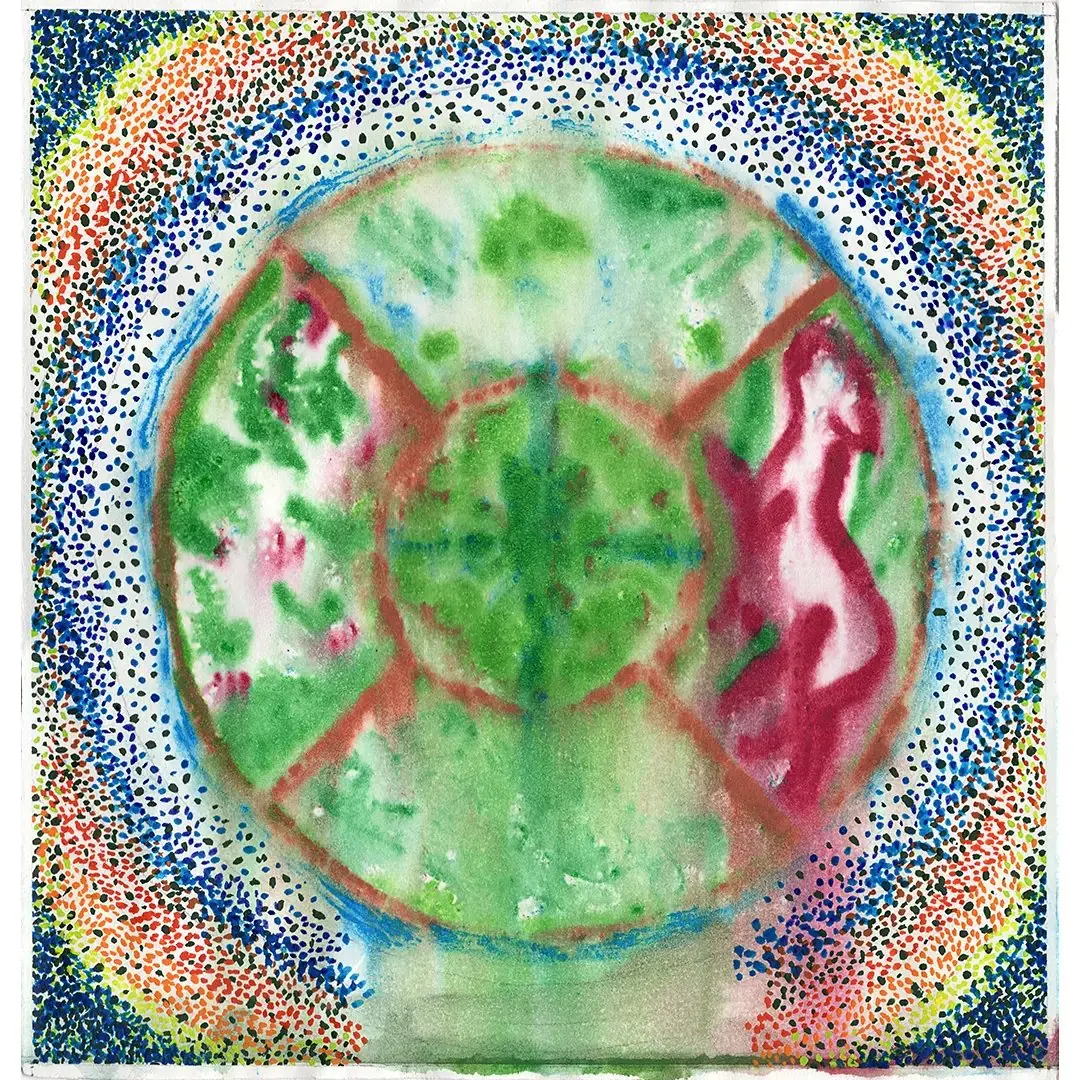
LineageTwo inheritances
Parslow's influences are easy to read. On one side stand the great intimists and colorists of the domestic interior: Bonnard above all, whose bathrooms and breakfast tables he studied closely, along with Vuillard, Diebenkorn's drawings of the figure in a chair, and Alice Neel's frank sitters. On the other stand the alchemists of material: Sigmar Polke, for whom the chemistry of the picture was its content; Anni Albers and the logic of the weave; Howardena Pindell's punched and layered dots. Beneath both runs a third current: a real interest in self-taught and outsider artists, and the directness of work made outside any academy.
The mature work brings these inheritances together in a way that is his own. Its subjects are domestic and devotional, close to home in the spirit of Bonnard. Its methods are carefully chemical, in the spirit of Polke. Its line has the directness of the outsiders. His student exercises show the groundwork: master copies, an exquisite corpse drawn across six sheets of notebook paper, a red sketch made in the galleries of the Metropolitan Museum. A 2018 underpainting of tangled lily pads already carries the color pairing he still uses, a saturated orange or red set against a cool indigo.
2019The first sustained run
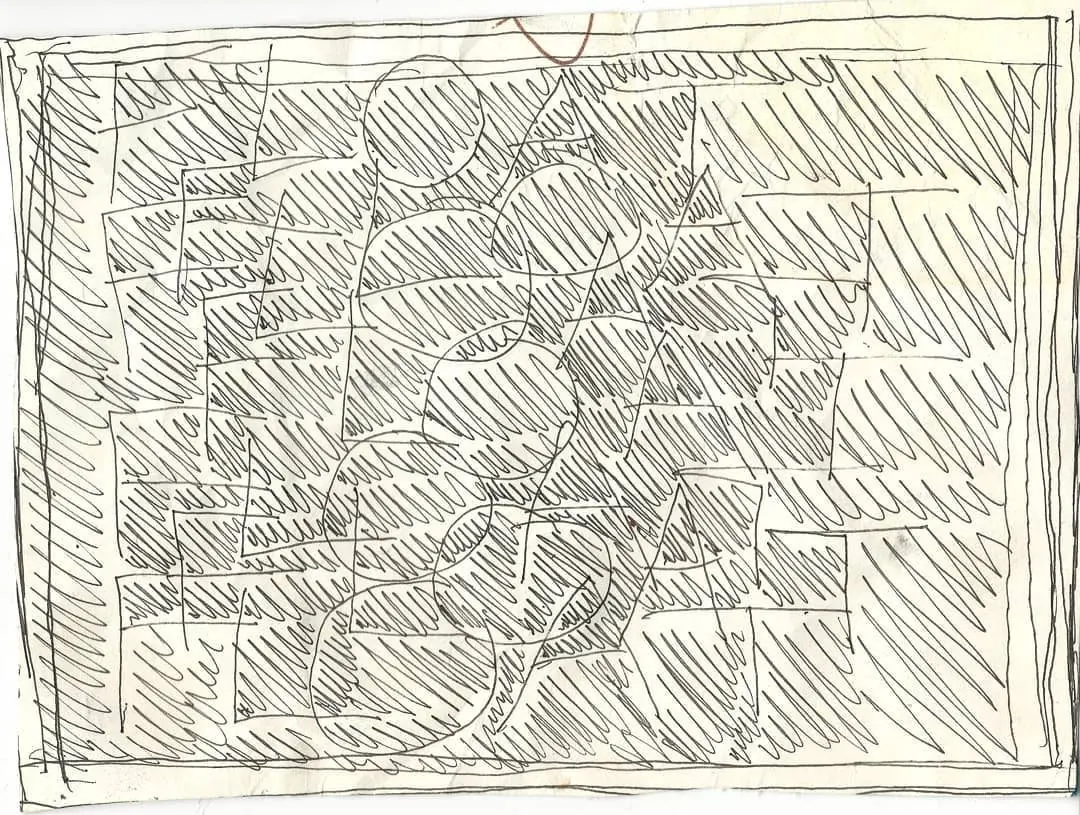
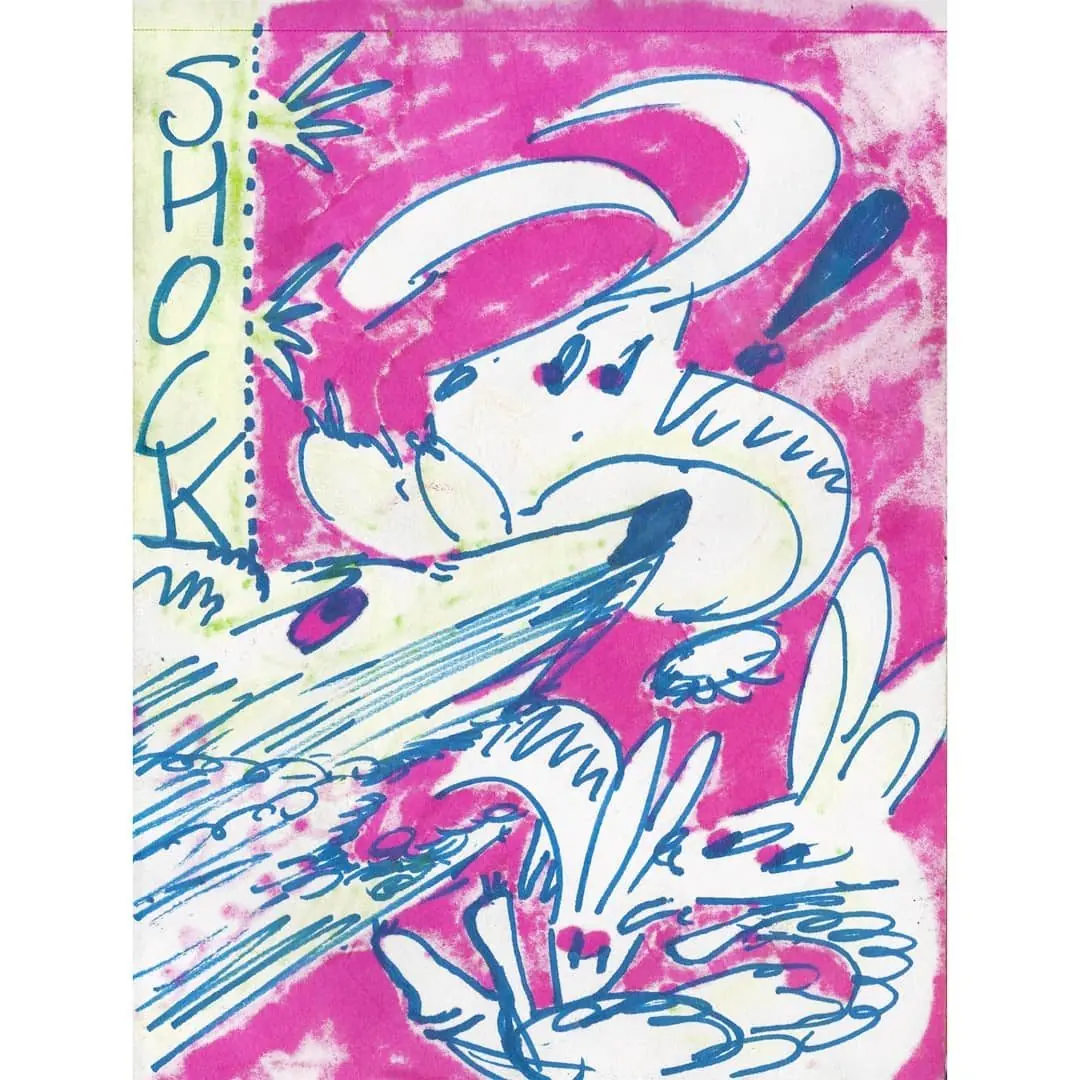
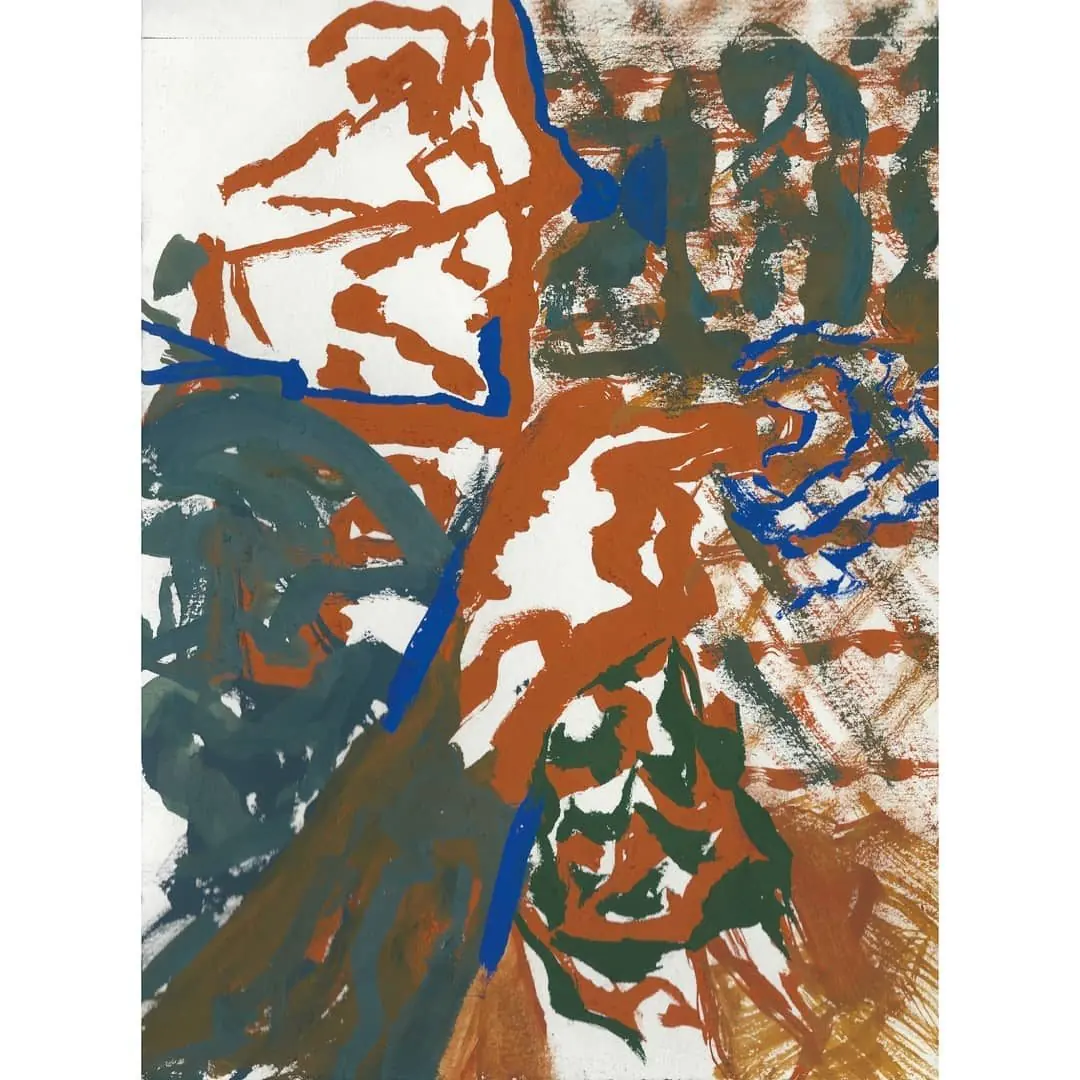
In the spring of 2019 Parslow produced a group of small works with one-word titles that show a wide range. Float is a pen drawing of hatched rectangles, a ledger set gently adrift. Jump, in hot-pink and blue marker with the word "SHOCK" running down its margin, renders an explosion in the language of a comic strip. Point is gouache, a thicket of branches in rust, navy and green. Each works in a different voice, and together they show an artist comfortable moving between tools.
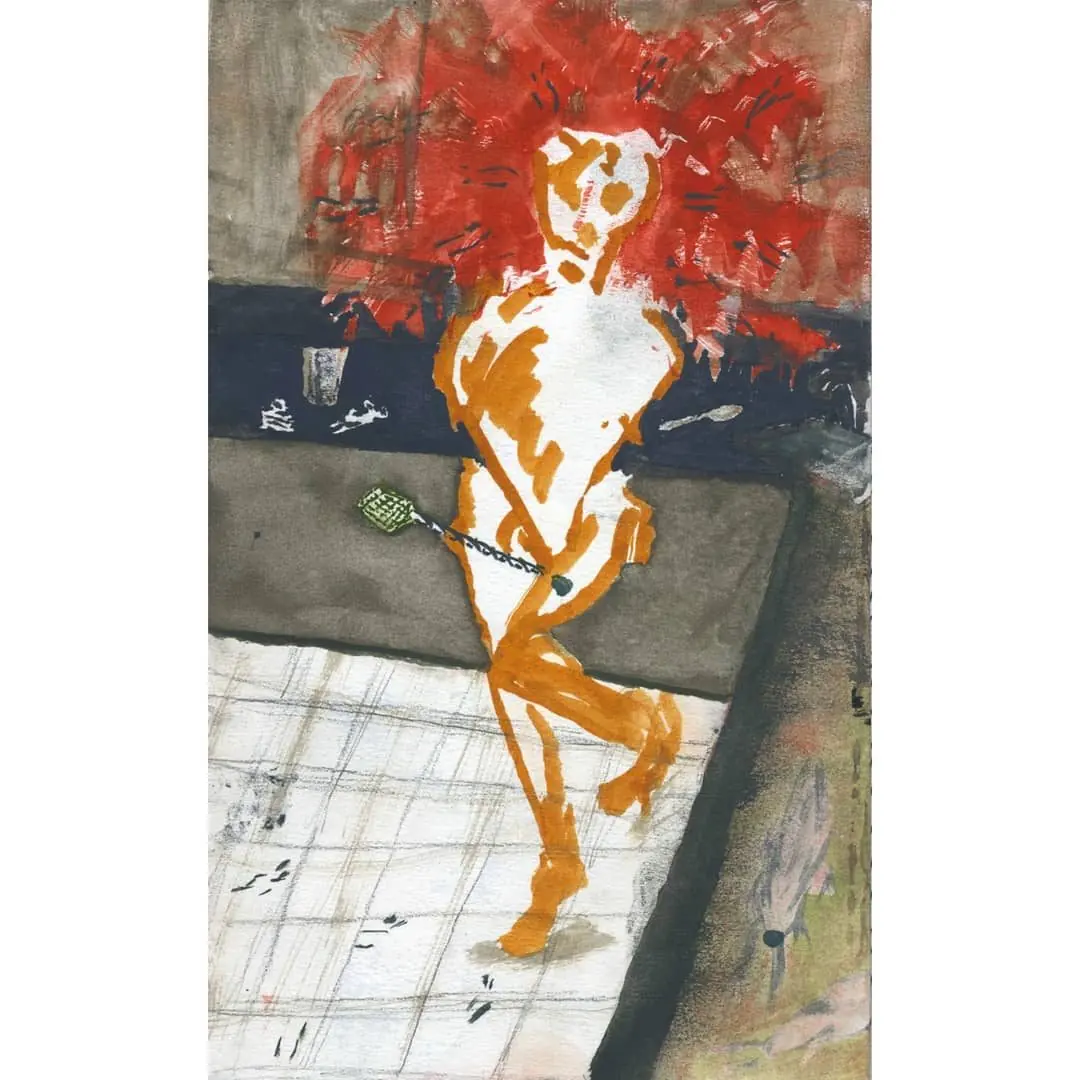
That June a dozen of his works were shown at Velvet Ropes, a one-day exhibition in New York staged across Shrine and Sargent's Daughters. The pivotal work of the year came that autumn. Threat Signals is a small gouache-and-pencil sheet: an orange nude striding across a tiled floor, its head blazing into a red corona, a flyswatter at its side. In an accompanying text Parslow writes candidly about obsessive-compulsive disorder and its insistence that insects are a menace he alone must eliminate. His answer is to imagine himself as the creature he fears. "Bug empathy is good for the soul," he concludes.
That sentence is a key to everything that follows. Moths, cicada killers, roaches, robins and paper wasps fill the later work, and each is treated as a fellow creature, drawn with the same care he gives a hand or a face. It is a humane impulse, and it gives the work much of its warmth.
2020The plate and the screen
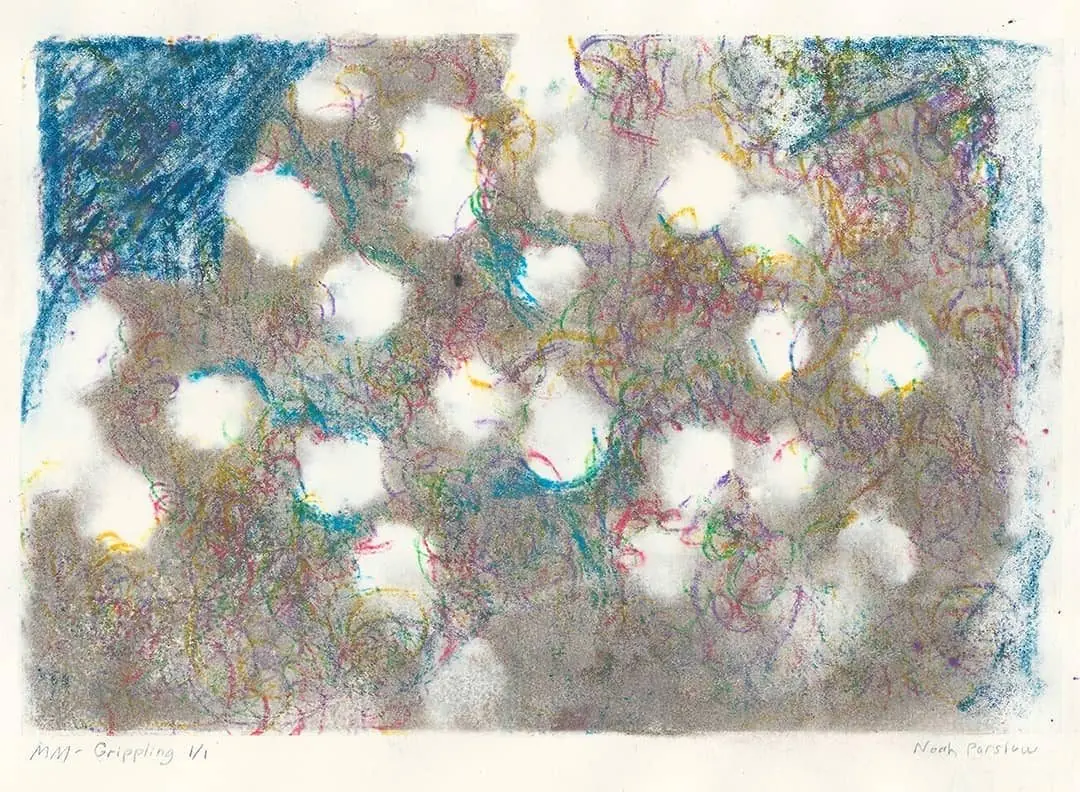
In 2020 Parslow took up printmaking, and it suited him right away. He began pulling monotypes from sanded mylar plates, working the surface in watercolor, aquarelle crayon and gum arabic and pressing each sheet by hand, balancing the pressure so the pigment grips. He likes what the monotype gives him: texture he can't fully plan, and some surprise with every pull. Grippling, the first impression from one such plate, is a field of grey and polychrome scribble opened by soft white voids, like snow falling through static. Its title folds together crippling, gripping and stippling. Its second, fainter impression, the ghost print, he describes in five words: "Scales on leaves, fall rot, arrival of snow." The second pull is the first one's afterimage, a picture of what lingers.
The same year opened a more conceptual line of inquiry. Disoioriorented takes its source imagery from amateur digital illustration: anime figures, drawings of nurses, pictures made by children who use software to depict being ill. Parslow has written that he sees "a lot of paintings to be made" in this material, and he follows through on it. The finished work carries a clean digital figure into smeared reds and greens, restoring the bleed and touch the screen leaves out. Glare and a related untitled sheet do the same with inkjet transfers of found digital drawings, painted over until the flat source softens. Later works carry the project into language, including a sheet of texts transcribed verbatim from online art forums, lettered by hand in red marker, and an animation built from drawings based on children's depictions of their own migraine auras.
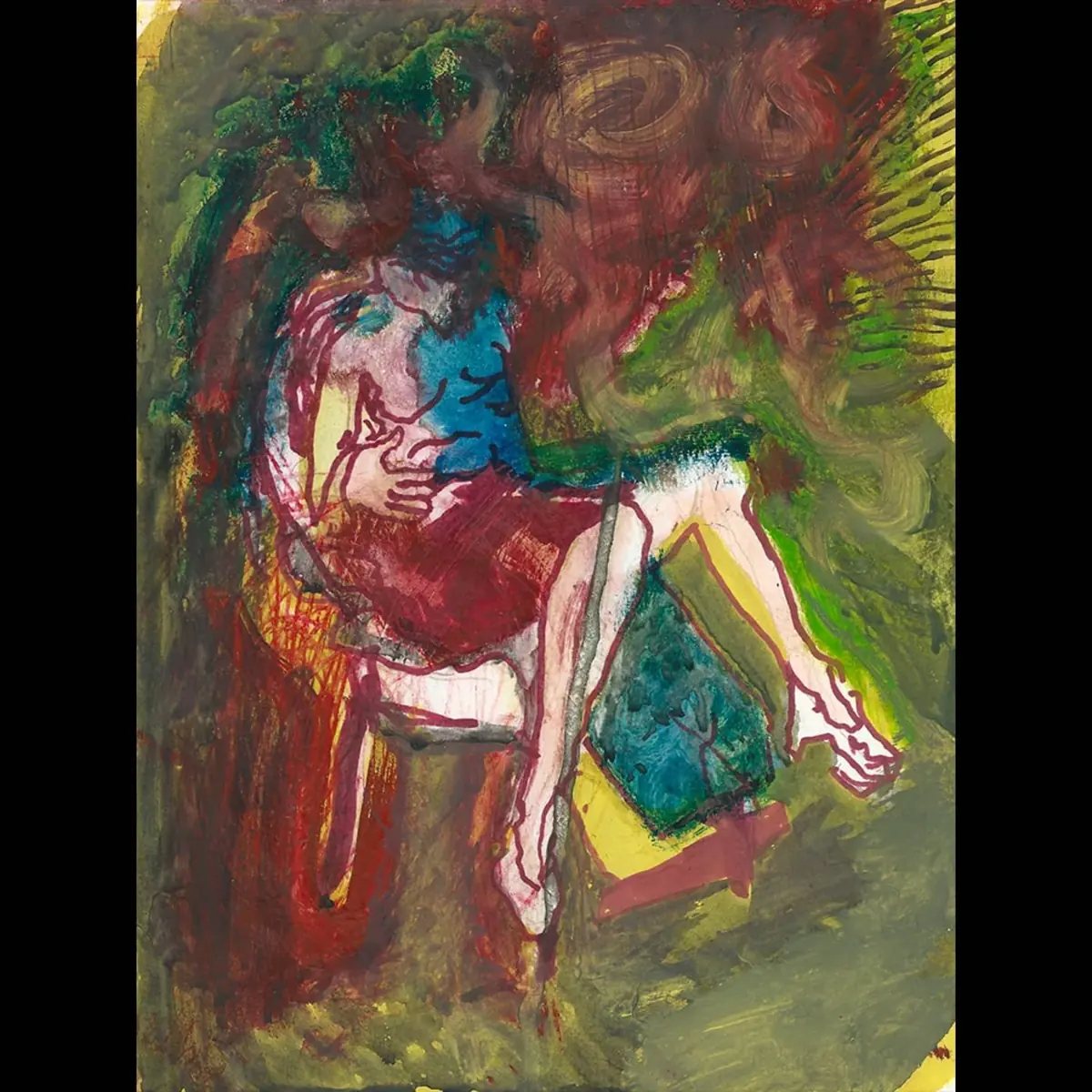
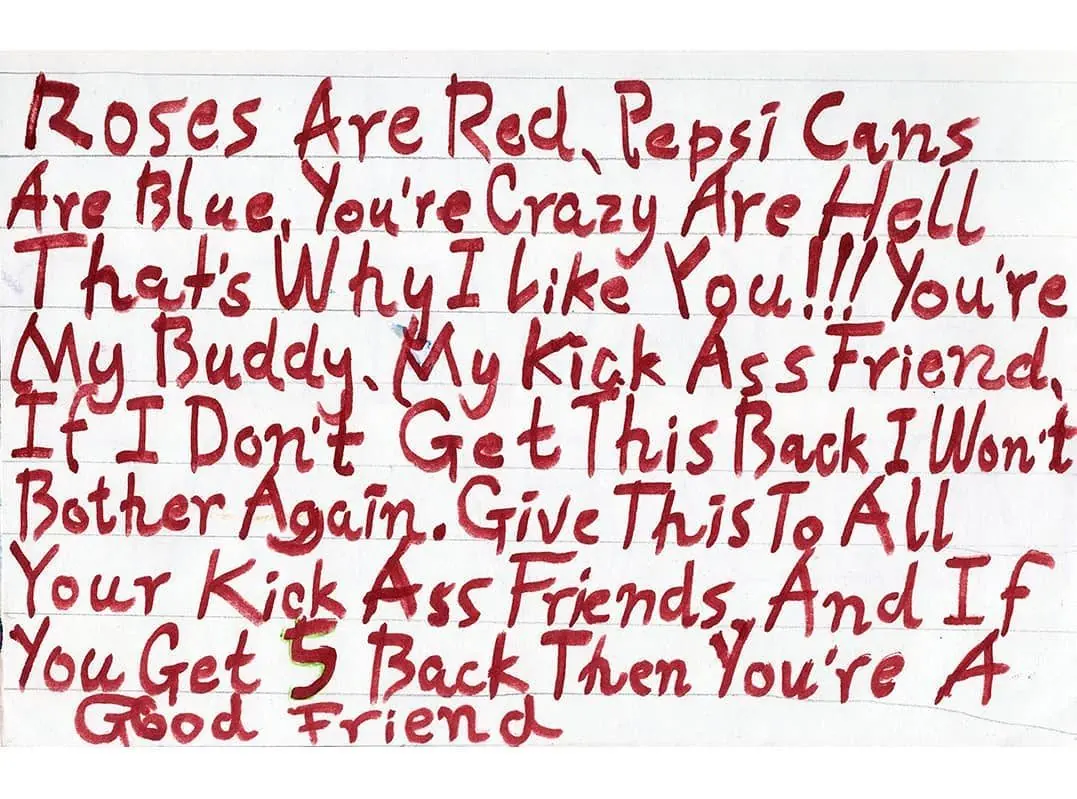
This is one of the most original ideas in the work. A generation, many of its members chronically ill, now pictures its inner life in media that cannot smudge, and Parslow shows how painting can give back the bleed, the accident and the warmth of a body at work. It is a sharp observation, and he approaches it with compassion.
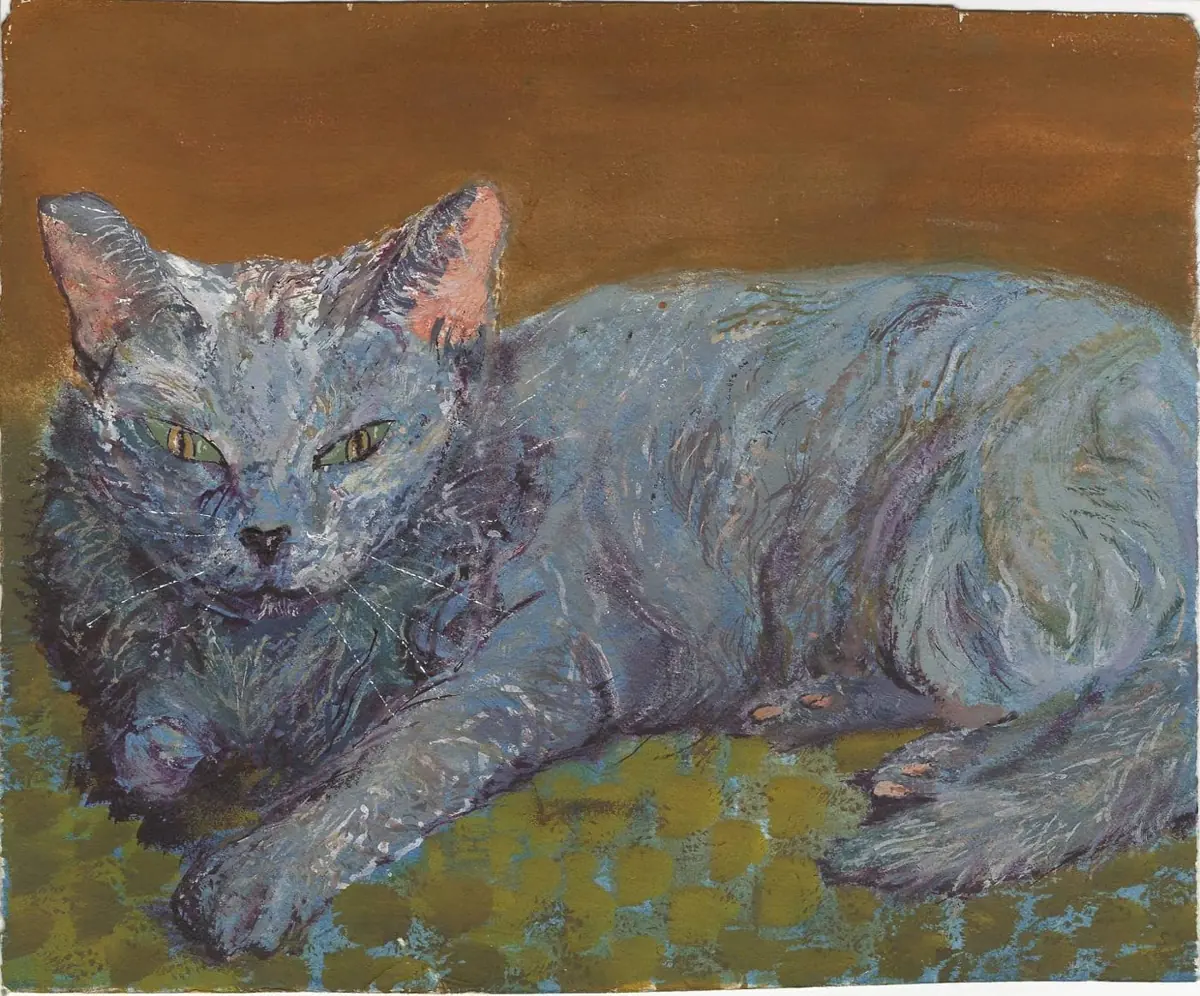
The year also produced Miso, a commissioned portrait of a cat on rag paper the artist dyed himself with organic indigo. The coat is built from a multitude of short, cool strokes laid over a mustard ground, and the result is exact without being stiff.
2021The mudras
The series at the center of Parslow's work began in a sketchbook. Through the summer and autumn of 2021 he traced his own hands, which were sore at the time, and filled the outlines in. The resulting works take their titles from the mudras, the sacred hand gestures of Buddhist iconography: Abhayamudra, the raised palm of fearlessness; Dhyani mudra, the hands of meditation; and Gross Unraveling, a partial Dharmachakra, the gesture that turns the wheel of teaching.
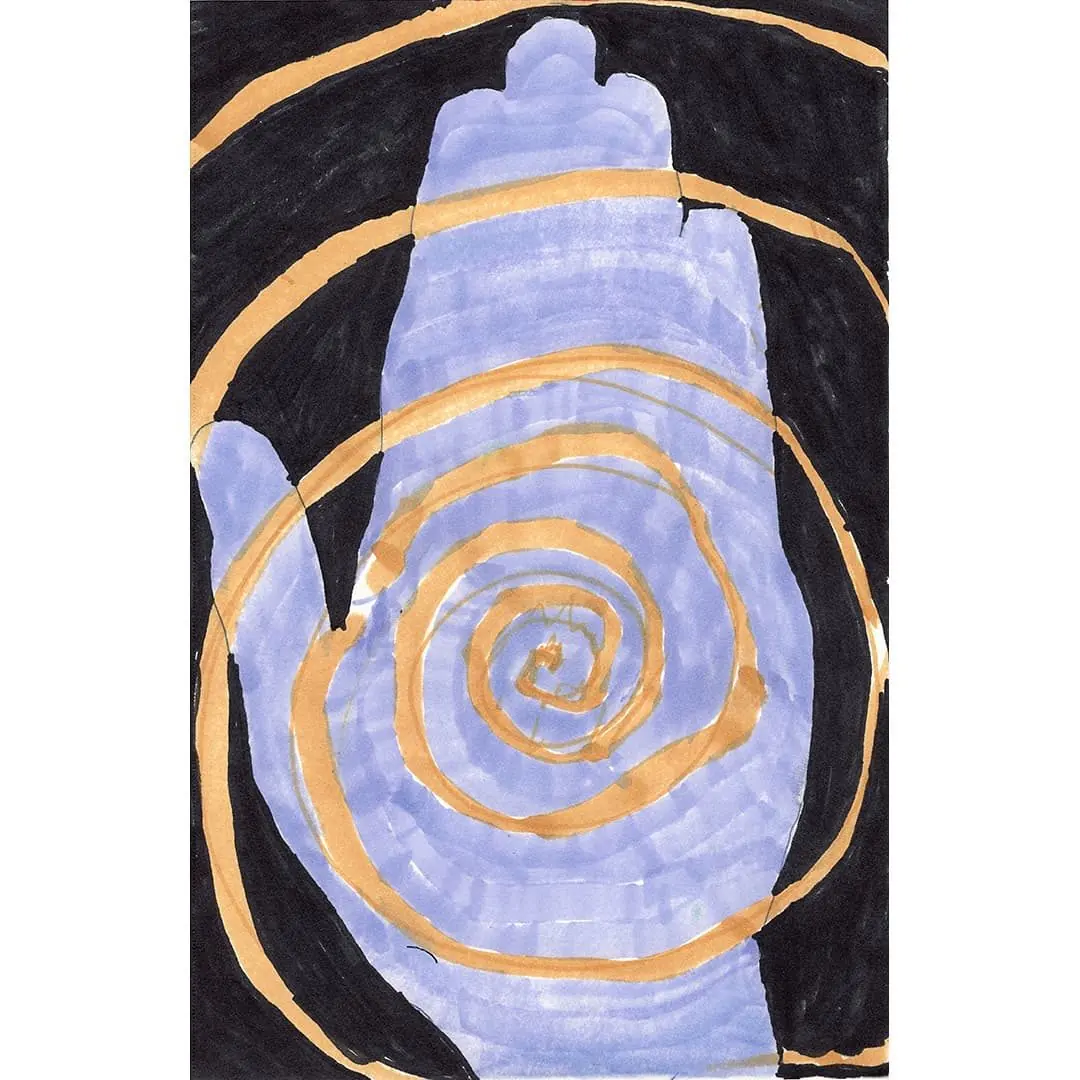
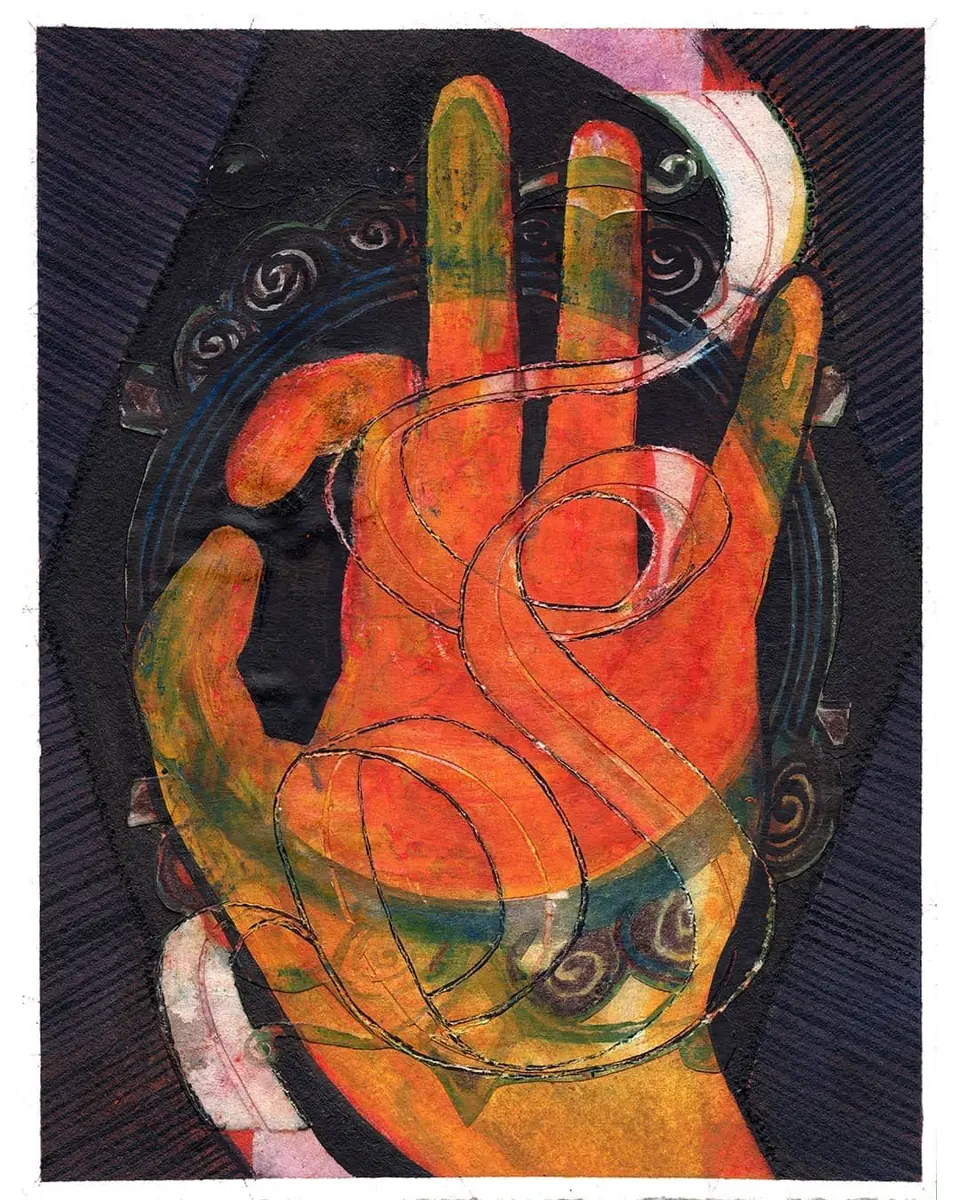
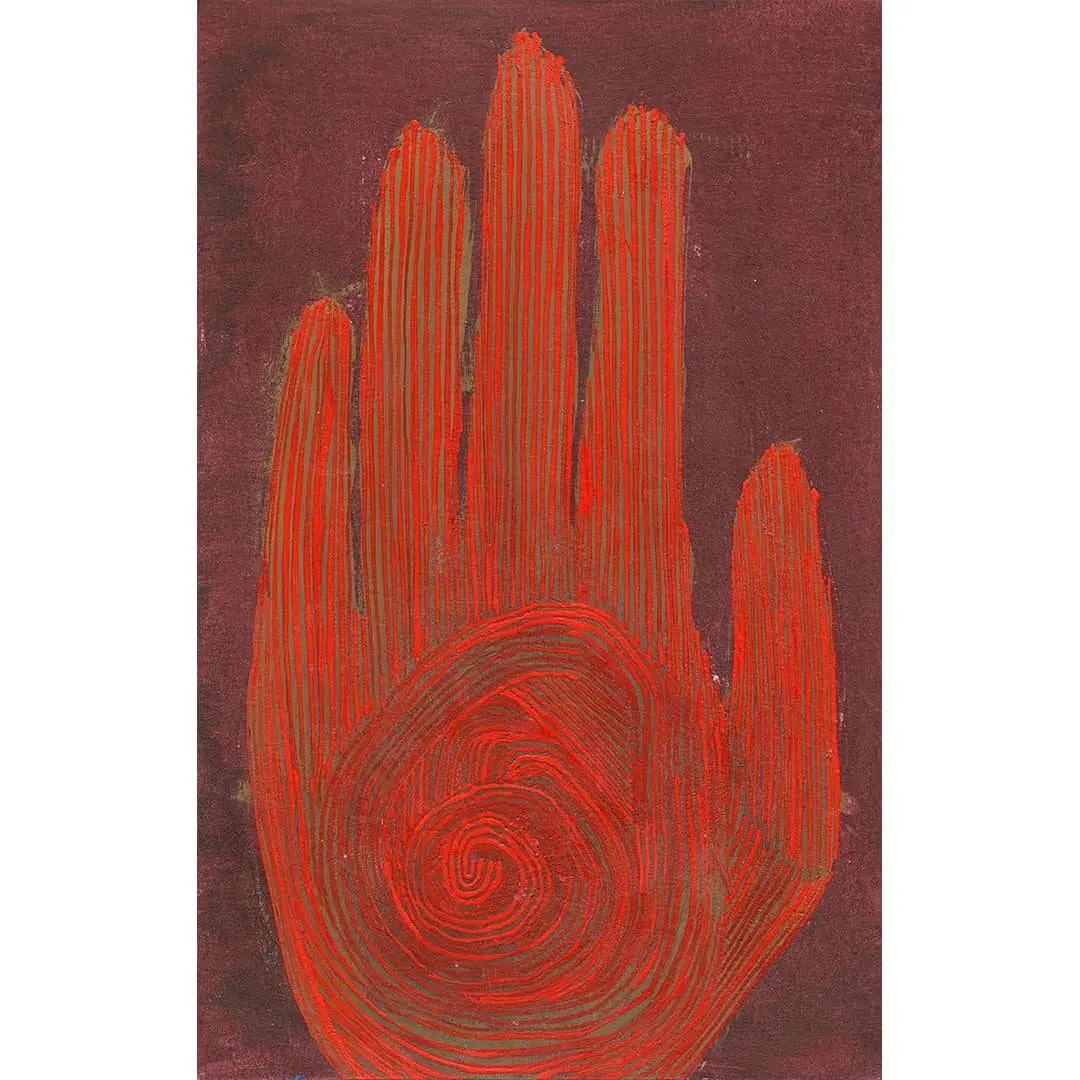
The way these are made is what makes them work. Parslow burnishes the gouache back with a copper brush, abrades the paper, floods washes with ox gall so the pigment blooms and travels, and draws back in with crayon and pencil. The hands take on a weathered, almost archaeological surface, like a fresco fragment or a palm print on the wall of a cave. The tracing gives each one a quiet authority, because it is the artist's actual hand at actual scale: the gesture is both a record and an icon. The series lives between the body as it is and the body as the iconography imagines it. It is the strongest group in the work.
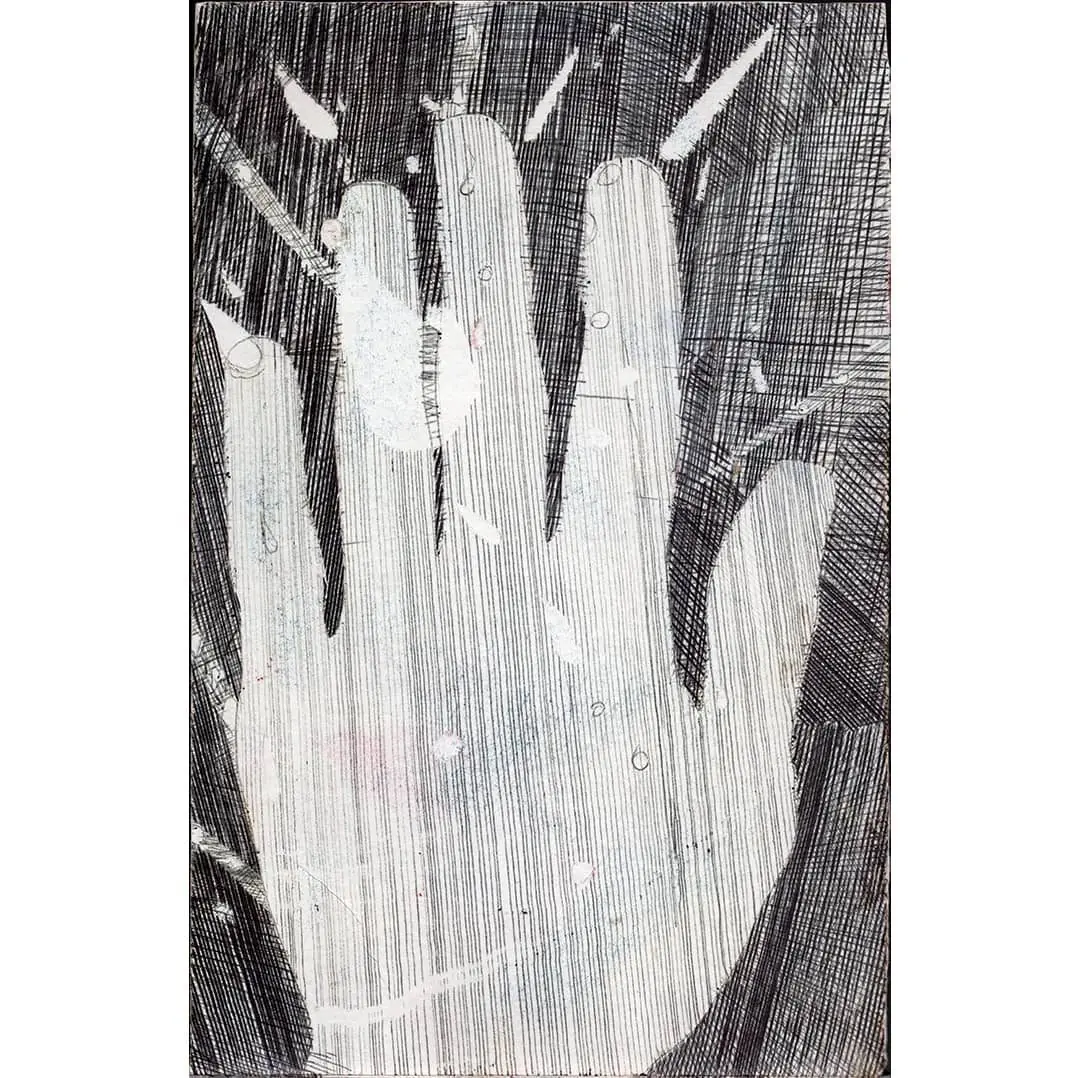
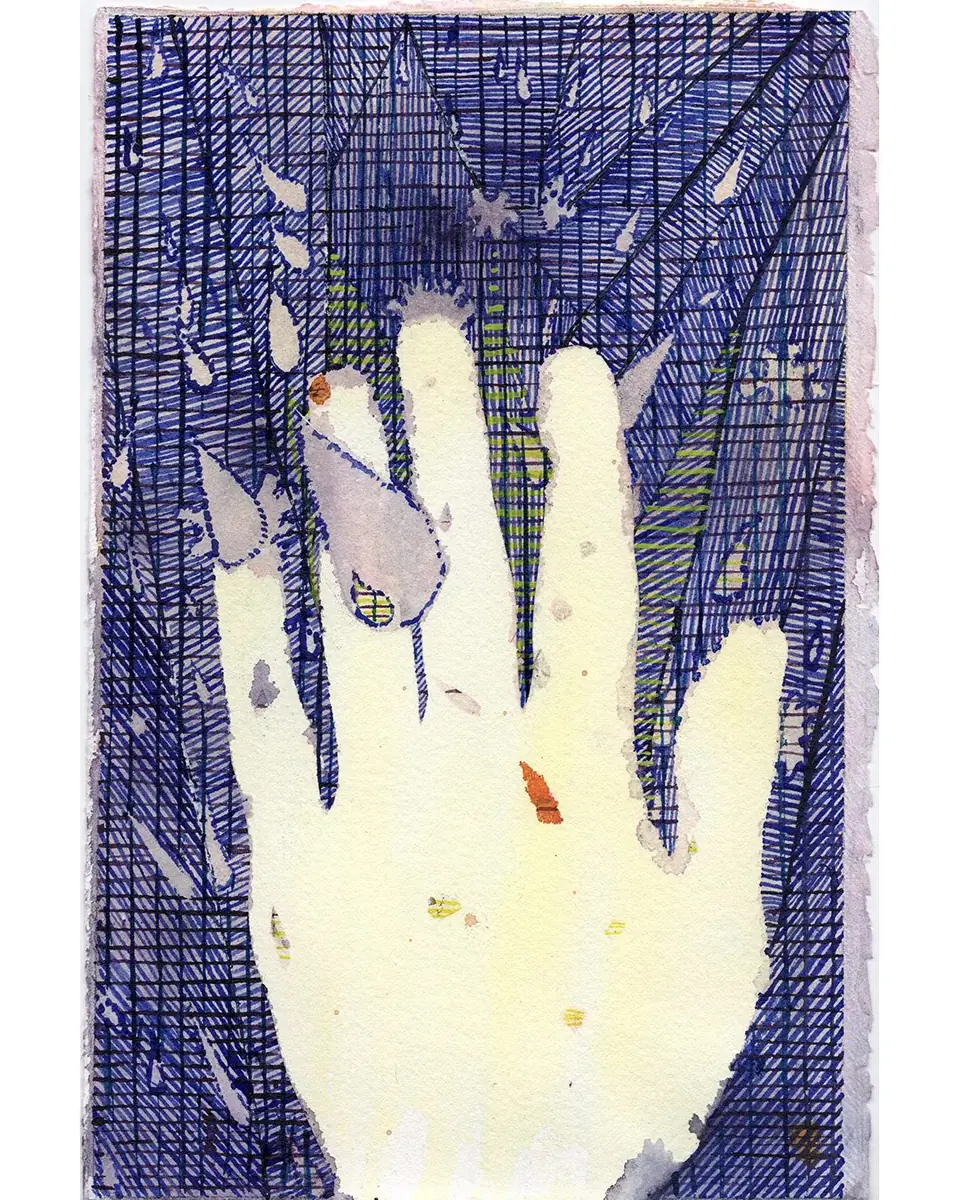
The hands continue into 2022, and the titles turn meteorological. Hand in Cold Dawn Rain, in ballpoint, crayon and graphite, sets a pale silhouette against a dark crosshatched ground streaked with white. Hand in Afternoon Sleet bleaches the hand to bone white against a hatched indigo field. Read in sequence, the series becomes a kind of weather diary: a single body outlined again and again while the seasons pass across it.
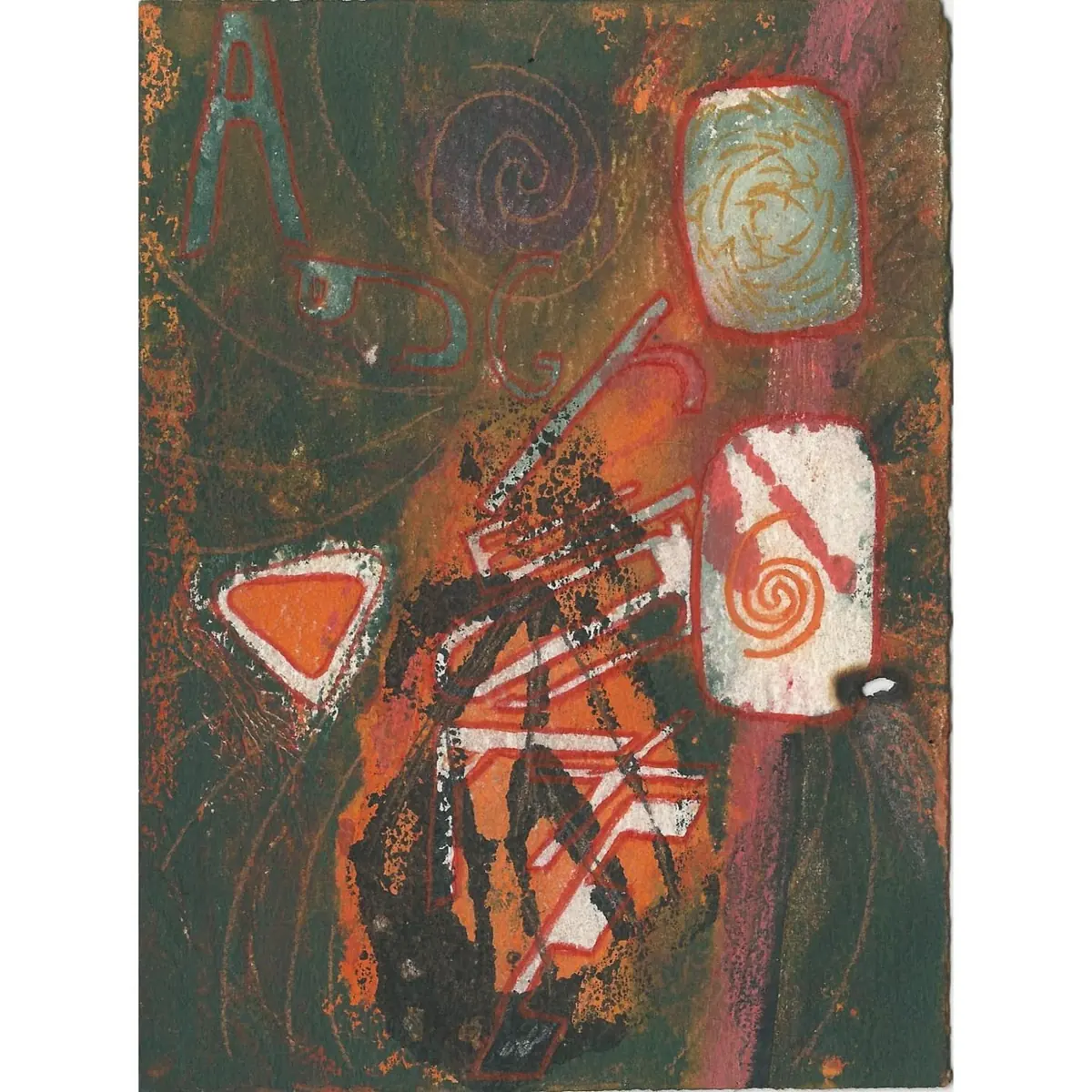
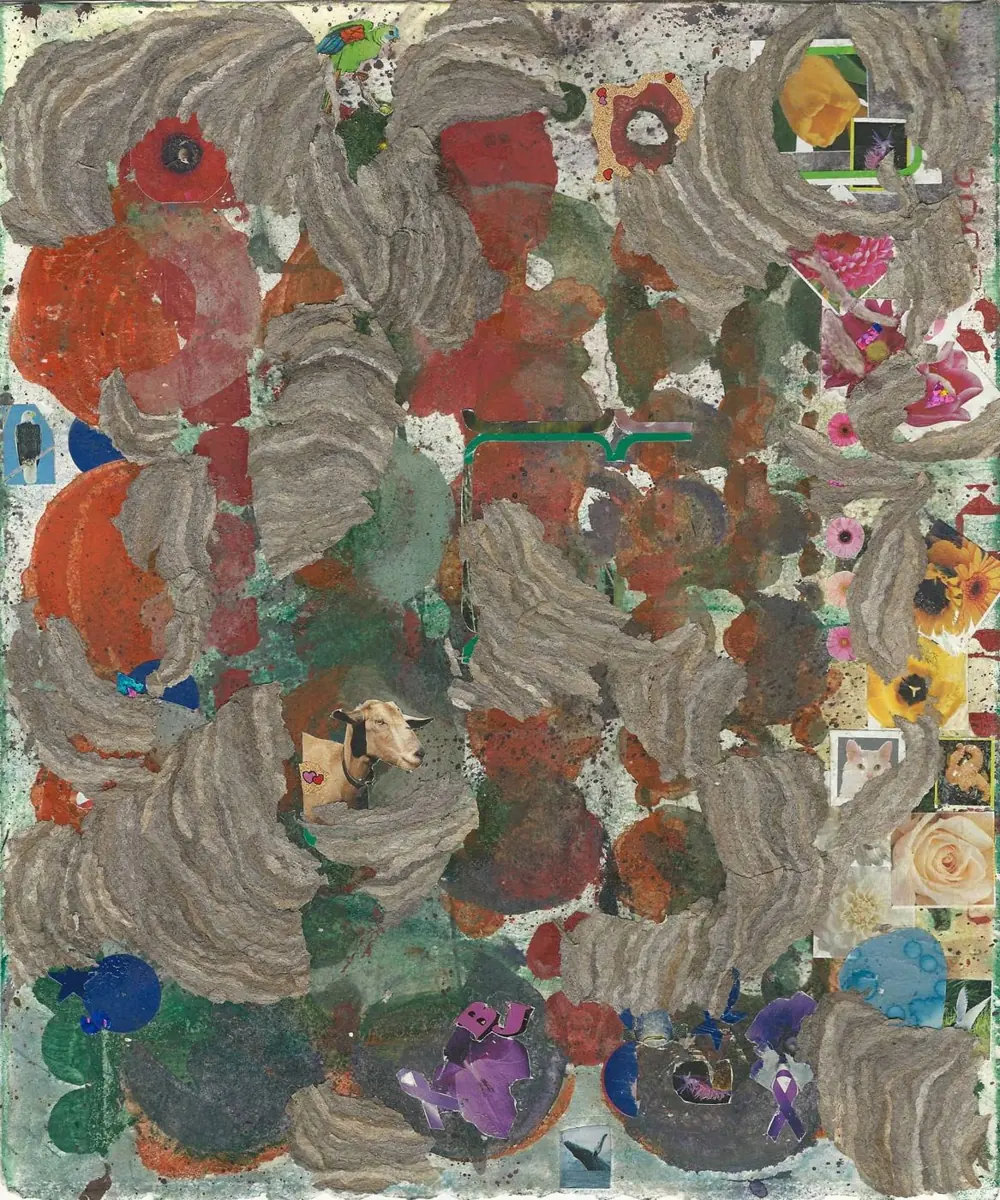
Two further works of 2021 show how far he pushed his materials. Nestled incorporates an actual paper wasp nest, the insects' chewed-wood pulp laid alongside the artist's own paper, so that two kinds of maker share the sheet. Aggregate, exhibited that summer at Peanuts Gallery beside a larger painting on paper, begins from the image of a monarch emerging from its chrysalis and ends as burnt-orange shards and white spirals on paper the artist deliberately singed. Metamorphosis is figured as fire, and fire as emergence.
2022–2023Moths, cats, and the monotype as elegy
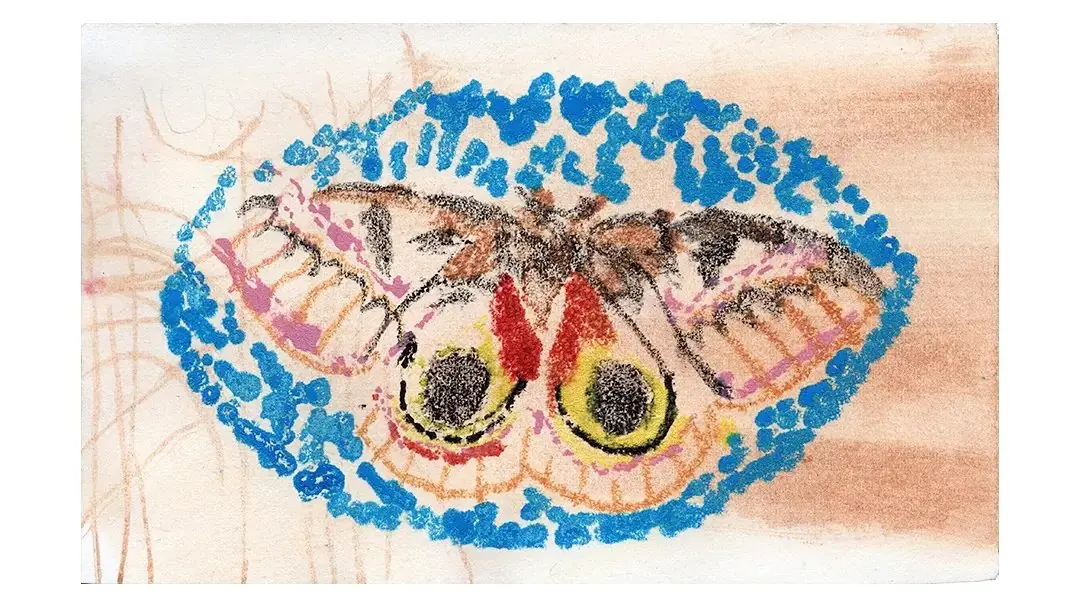
In the winter of 2022 the artist buried a beloved cat, Louie. While digging the grave, he has written, he was moved by the thought of the moths and other small creatures overwintering in the soil. That evening he made two small monotypes of Io moths, the species whose hindwings bear painted eyes, and drew the connection to a cat's eyes in their last moments. The prints are only a few inches across: a moth spread within a ring of blue stippling, two black-and-yellow eyespots returning the viewer's gaze. They show what he does best. Grief becomes care, extended to the smallest creatures, and a private loss becomes a lasting image.
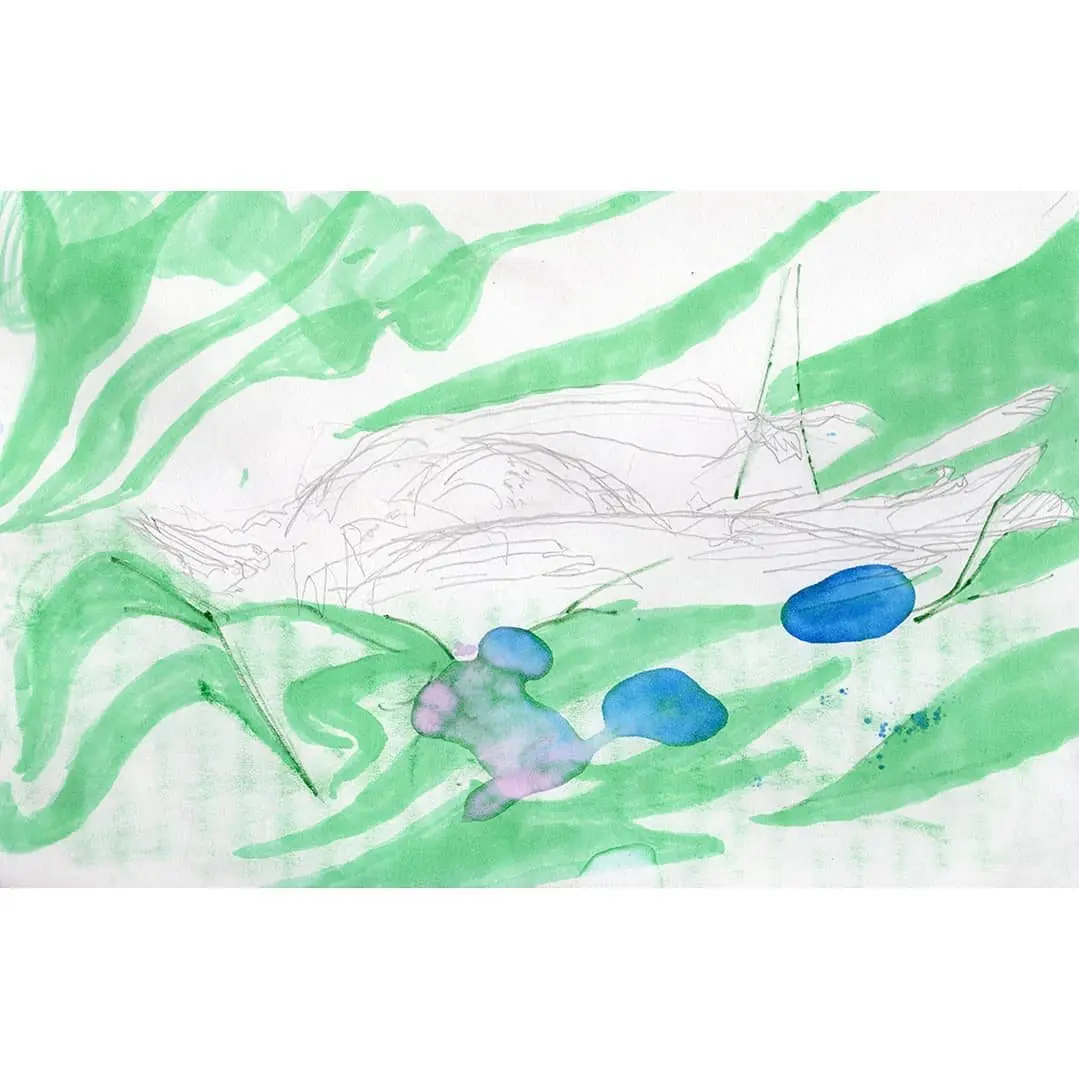
Robin Death, Mountain Burial comes from the same place. It was made in Montana after a summer spent observing birds, and the robin is drawn with the lightest touch: a delicate graphite outline beneath broad green strokes, with blue blooms where alcohol has moved the color. The artist's note observes that robins "die and rot beautifully" and adds at once that they are better alive, singing. That turn holds his whole temperament: clear-eyed, tender, and on the side of life.
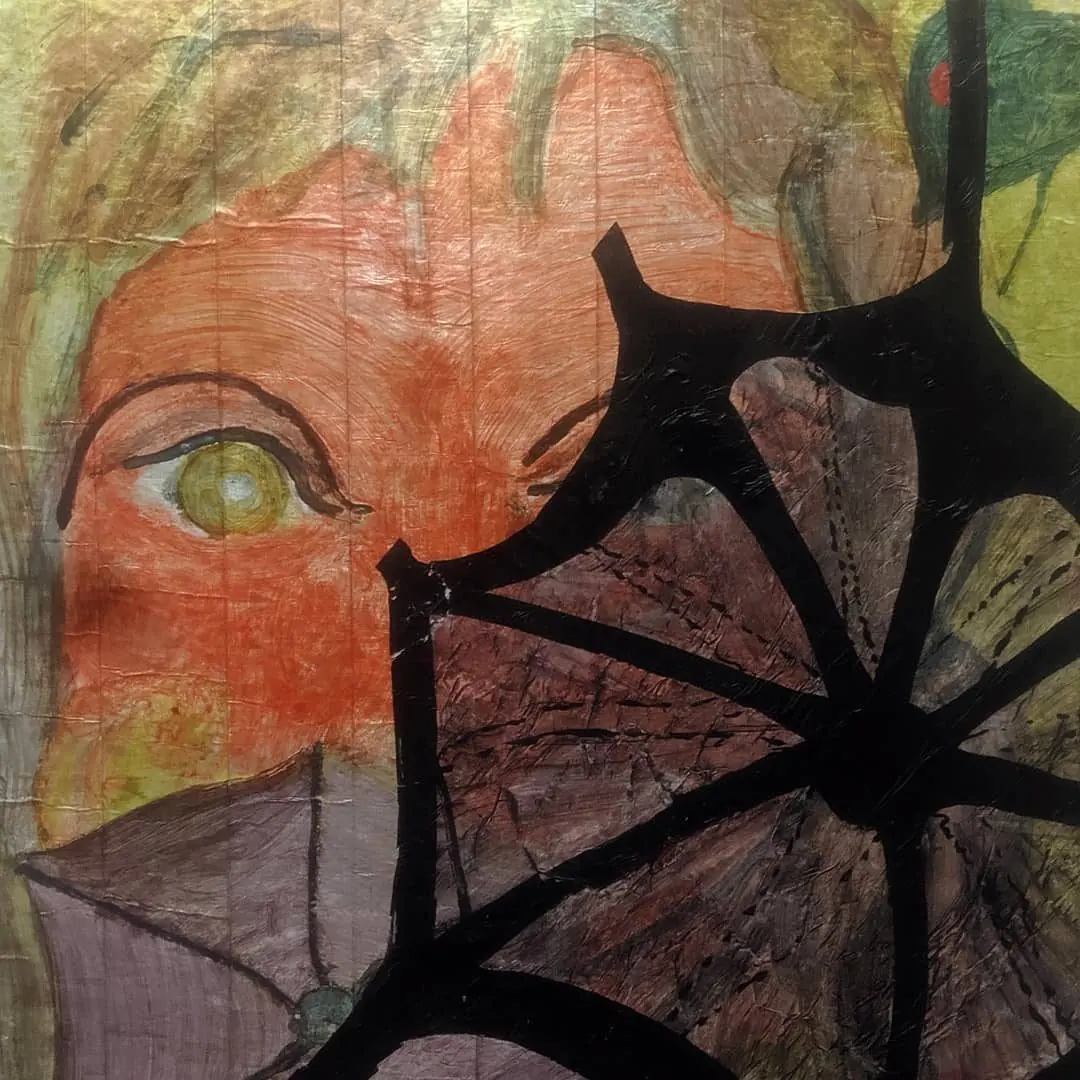
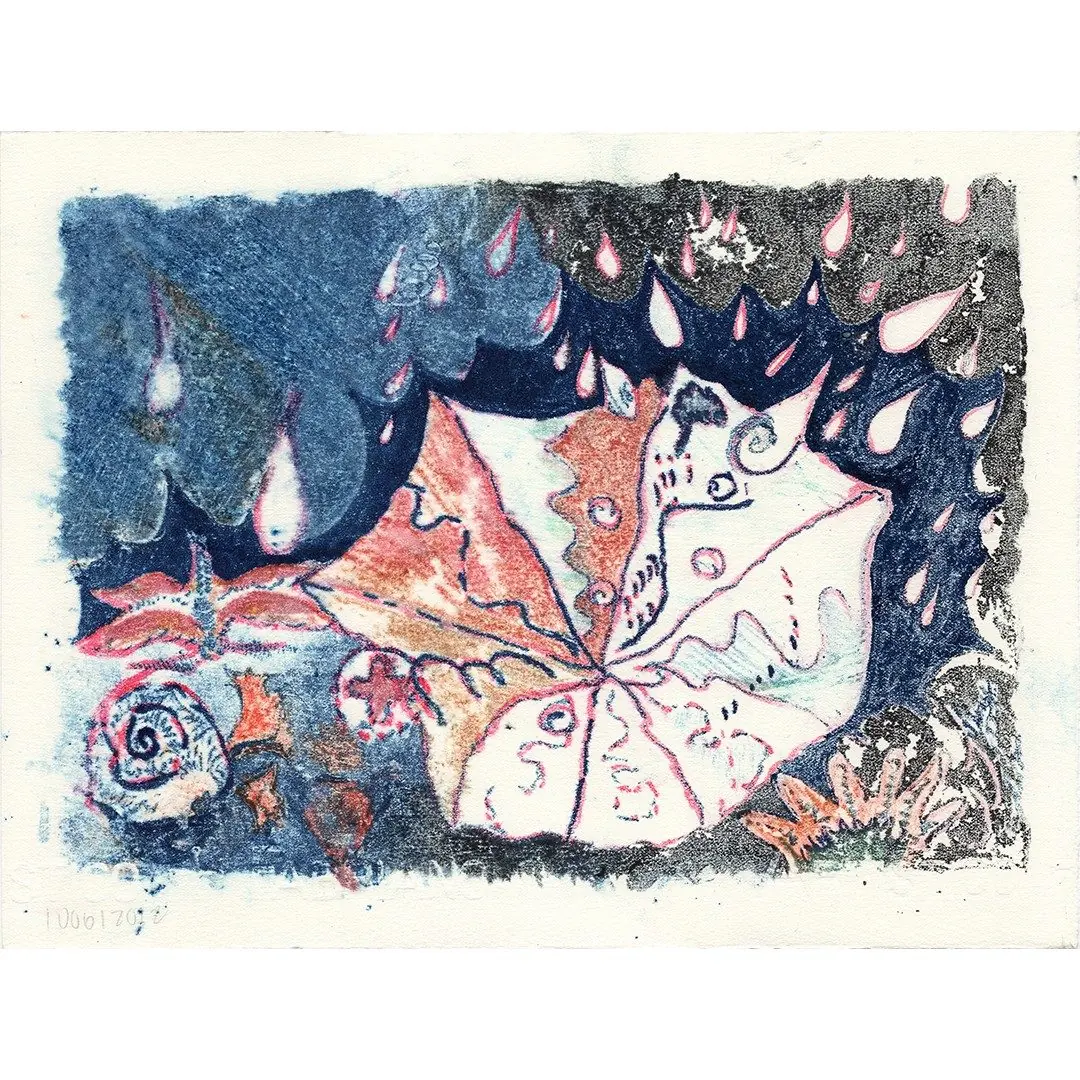
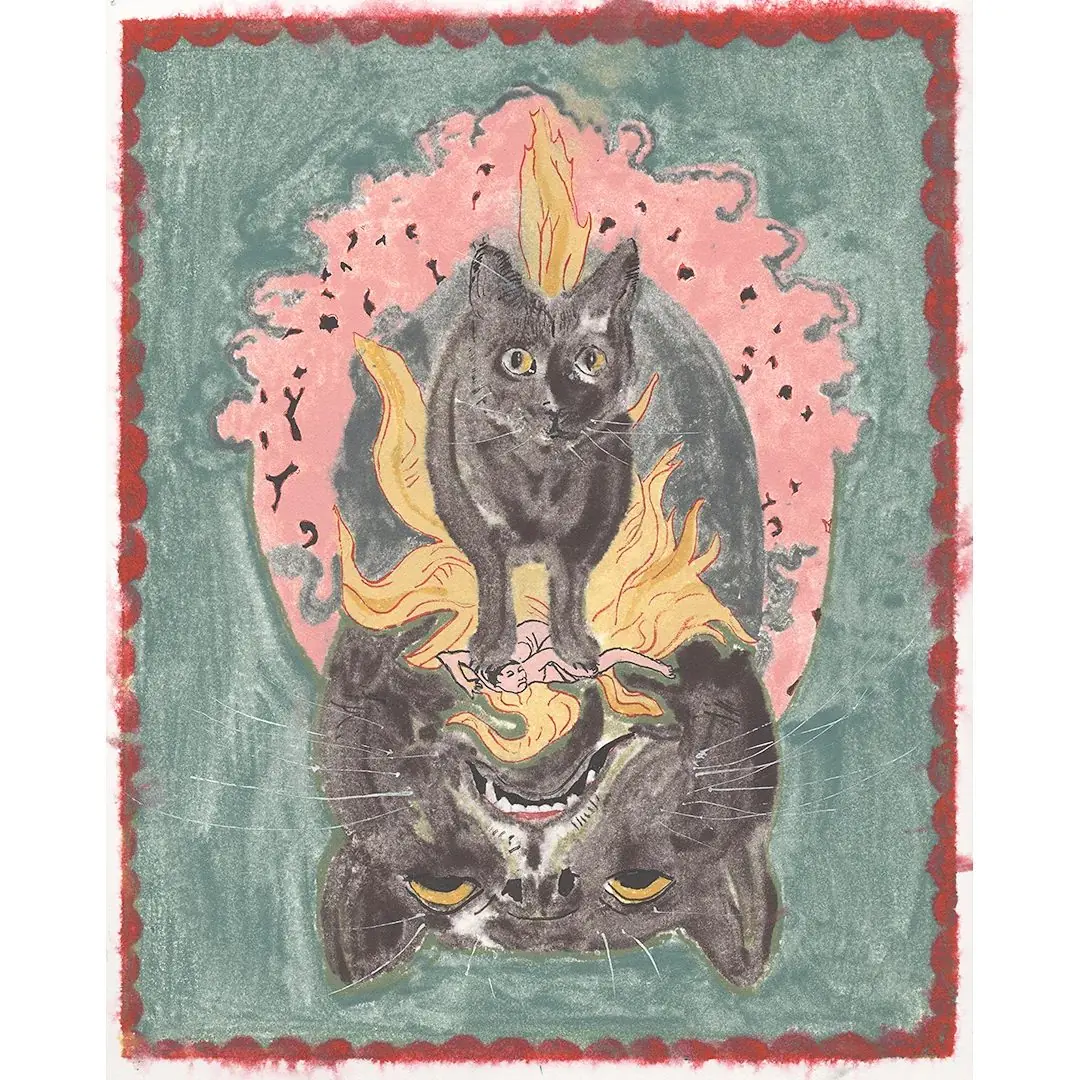
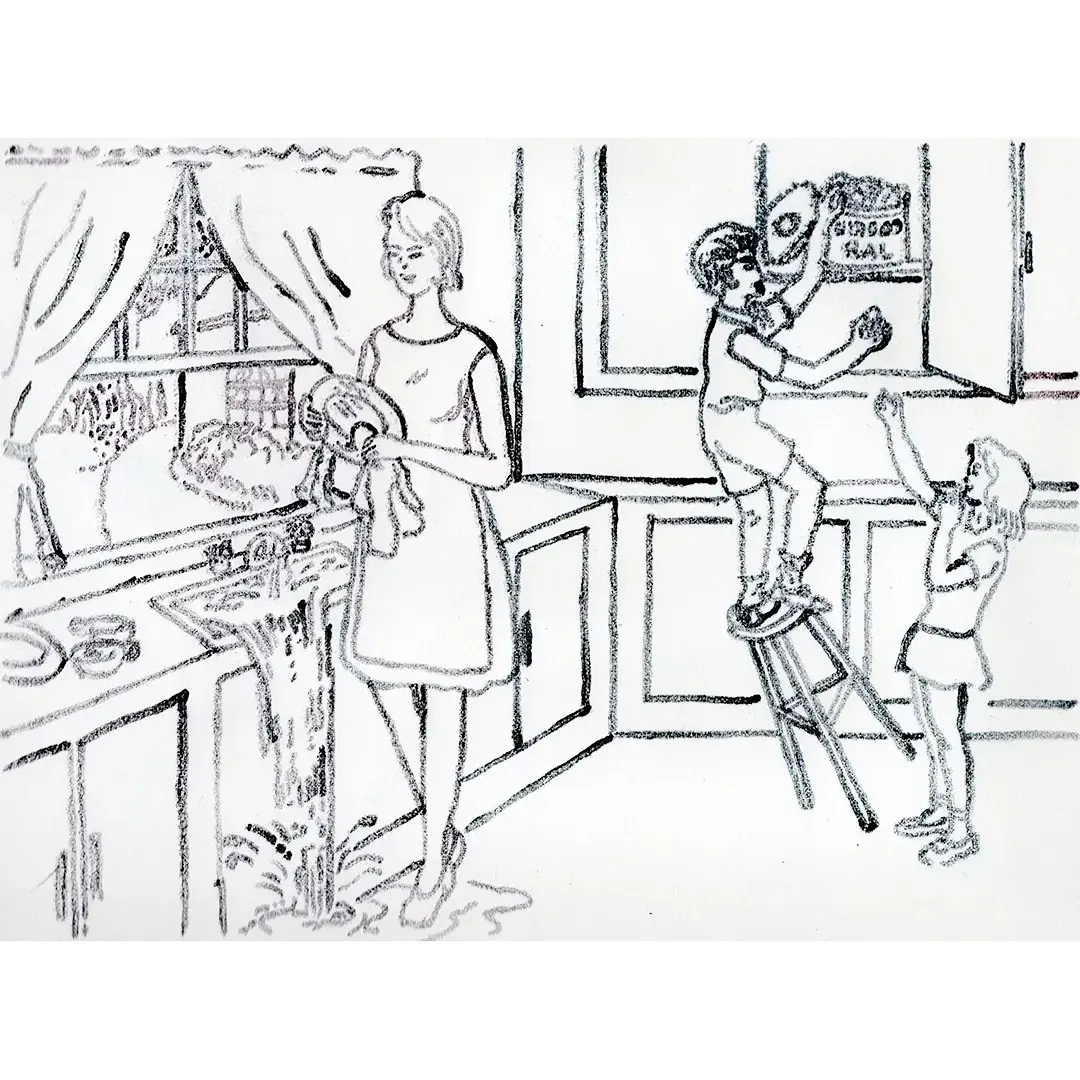
The monotypes of 2022 and 2023 are his most fully realized works. Sybil stacks two black cats, one upright and one inverted, wreathed in yellow flame against a pink aureole: a wrathful protector deity of Tibetan painting reimagined from the household. Moth and Flower Pheromones in the Rain, shown in a group exhibition of animal imagery, shelters a moth and an umbrella-like blossom beneath a serrated indigo canopy as rain falls from the upper corner. Unfamiliarity, a hand-pressed line monotype, depicts an ordinary kitchen with a woman drying dishes while two children climb a stool toward a cupboard, drawn with plain, warm clarity.
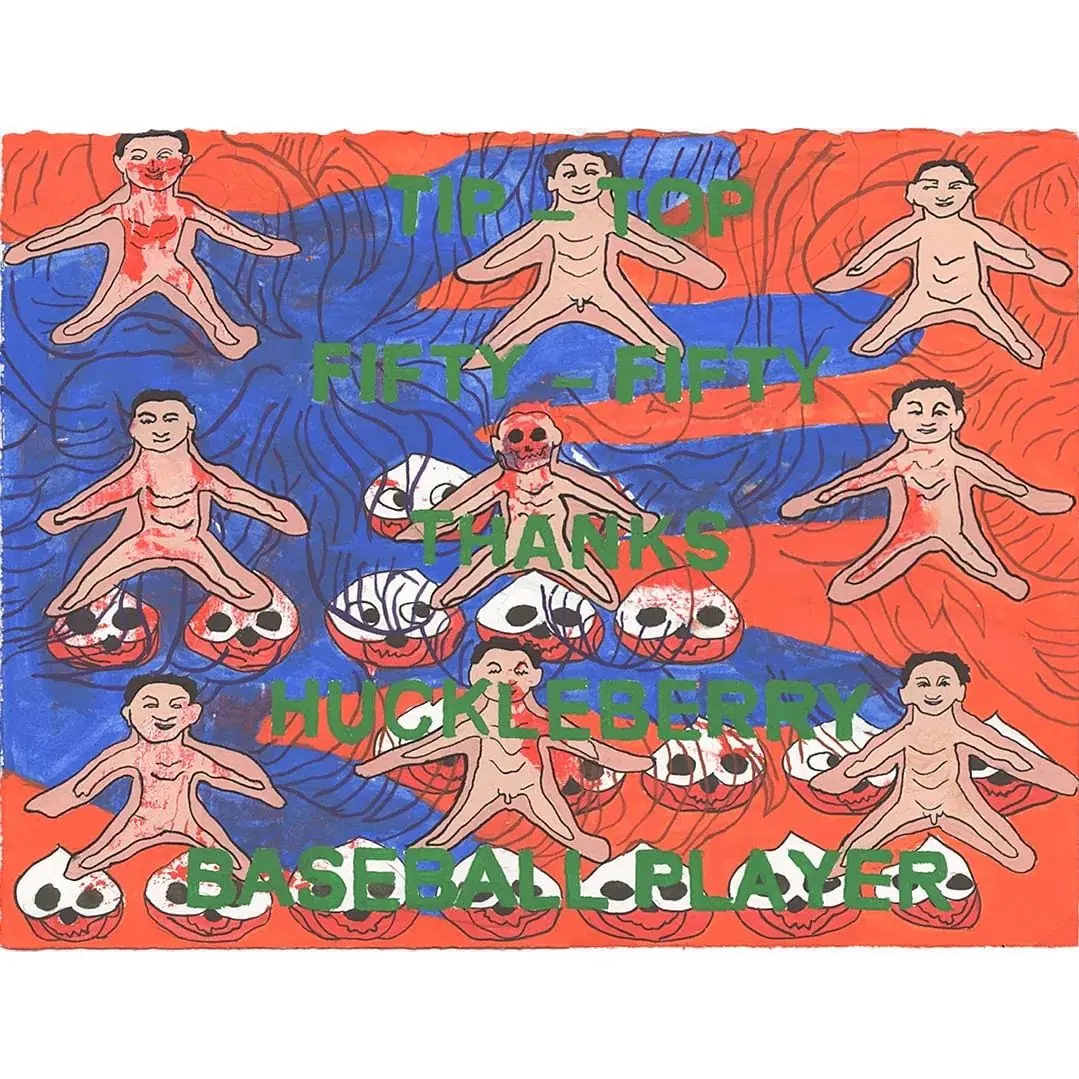
And then there is Tip-Top (Aphasia Assessment), the boldest picture in the group. A vast blue hand silhouette lies across a blazing orange field. Over it marches a grid of small grinning figures and a row of skulls. Down the center, in green block capitals, runs a sequence of words freed from syntax: "TIP-TOP FIFTY-FIFTY THANKS HUCKLEBERRY BASEBALL PLAYER." The subtitle refers to the clinical batteries used to assess aphasia, in which patients repeat strings of unrelated words. The painting holds joy and terror in the same frame, a difficult balance that he pulls off. It stays with you.
Language set free
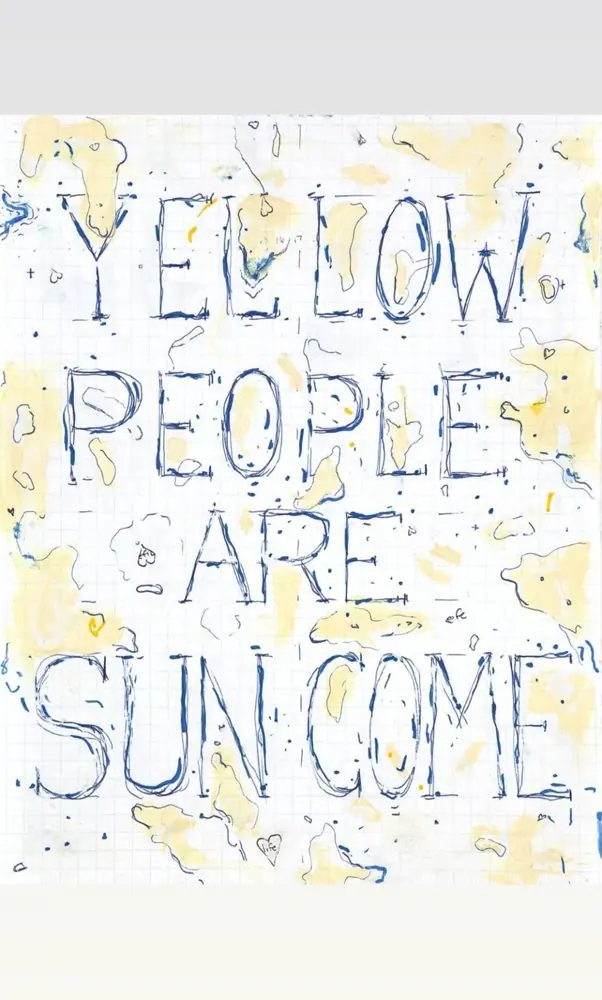
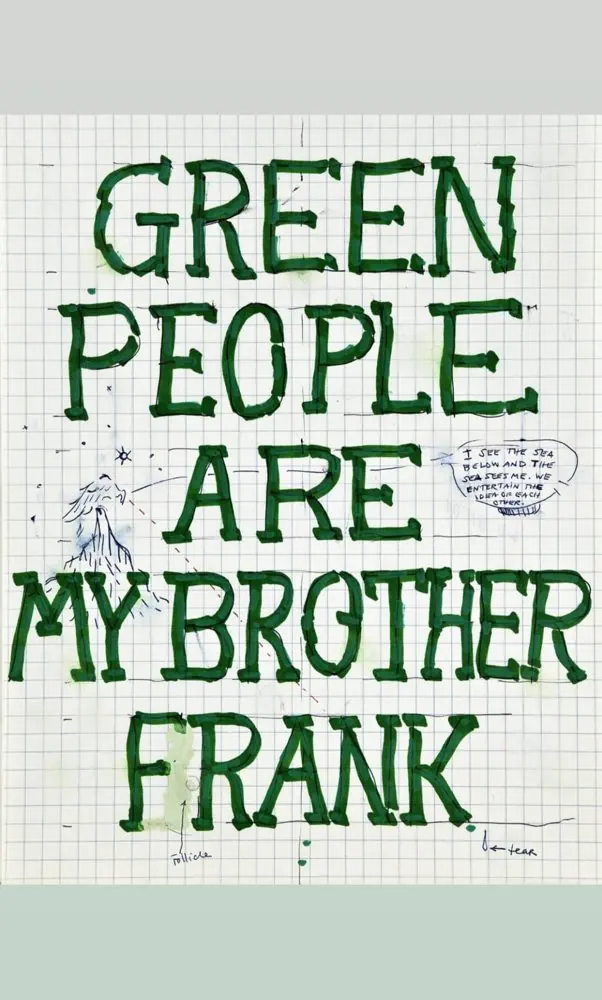
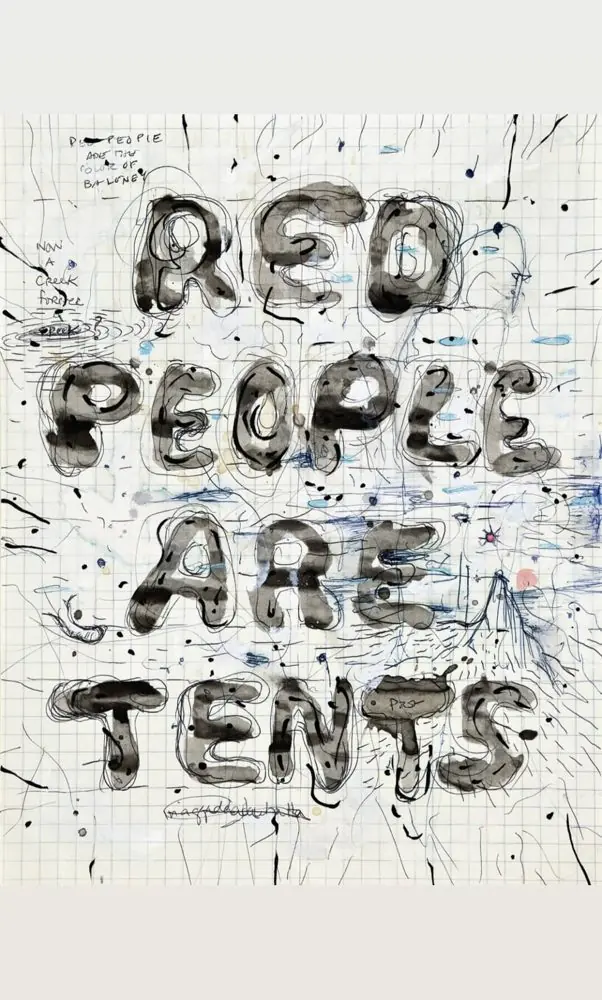
Tip-Top has companions. Around 2019 Parslow made a series of some twenty hand-lettered panels on graph paper, each sentence yoking a color, a "people," and a predicate that turns into something like poetry: "YELLOW PEOPLE ARE SUN COME," "RED PEOPLE ARE TENTS," "GREEN PEOPLE ARE MY BROTHER FRANK." They are funny and strange, and some brush deliberately against the language of race. Read together with the aphasia painting and the transcribed forum texts, they form a consistent strand in the work. In each, words slip loose from their usual meanings, and the artist delights in what they become once freed.
Method as meaning
The materials Parslow lists for each work read like a poetics. Ox gall, a wetting agent, makes watercolor spread and flower. Gum arabic, the binder, thickens it and lets a wash hold an edge. Alcohol drives pigment outward into pale rings. Burnishing and abrasion wear the surface back toward its origins. Translucent synthetic paper lets the paint float, unabsorbed, like weather on a windowpane. Prints are honored by impression: first pull, ghost. The sum is a painter who arranges a set of conditions and then lets something happen within them. That is why the weather titles feel so exact. He does not paint weather. He creates it, at the scale of a palm, and lets the image bloom inside it.
The Smile Cards
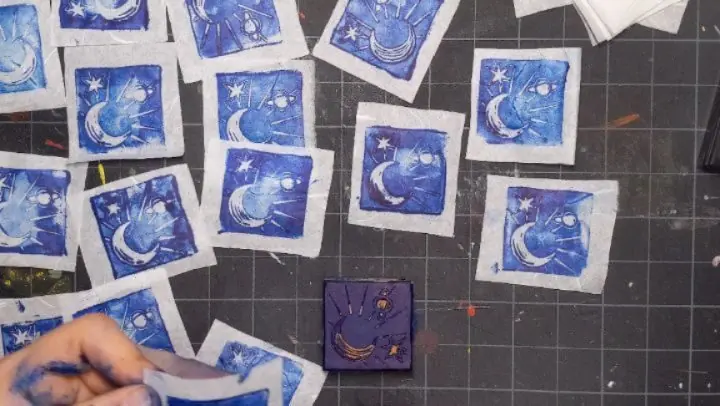
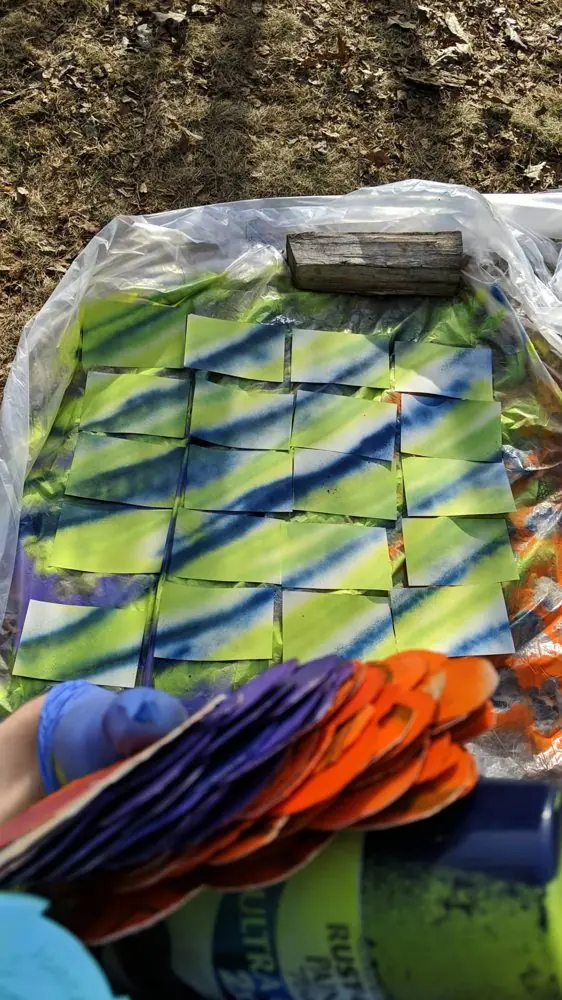
One body of work shows the generosity behind what he makes. In the winter of 2021 Parslow produced some thirty hand-printed cards for care packages assembled by the Power of 10 Foundation, a Minnesota organization that supports people living with chronic illness. Each card carries impressions from a linoleum stamp, a gift from the artist's father, printed onto rice paper and set into watercolor collage. Some of the blue cards are colored with organic indigo. Later batches were cut into flower shapes and dried outdoors on plastic sheeting before being sent. They are simple gifts, and they make visible the ethic that runs through the whole oeuvre: art as an act of care, extended to whoever, or whatever, is in need of it.
Verdict
Noah Parslow is a painter of conditions. His subjects are near at hand: his own palm, a robin, the family cat, a moth glimpsed for a moment in a Pennsylvania field. He renders them with a real command of his materials. In the mudras, the Io moths, Sybil, Grippling and Tip-Top, process and feeling become one, and each sheet seems to have lived through exactly what its title describes.
The hands alone would make a strong exhibition. Set beside the moths, the cats and the paintings after digital illness, they add up to something larger: a body of work with its own climate, made by an artist who knows exactly what his materials can do and what he wants them to carry. It is well worth spending time with.